The Gamification of Progressive Overload
Progressive overload is one of the most established principles in training.
At its core, it is simple: to improve, the body must be exposed to gradually increasing demands over time. More load, more control, more range of motion, more complexity, or more volume, applied intelligently and consistently.
Despite its simplicity, progressive overload is often misunderstood or poorly implemented. In many cases, it is reduced to a narrow idea of “adding weight to the bar,” or worse, confused with pushing harder until exhaustion becomes the metric of success.
But progressive overload is not just about load; it is about progression through time.
And that is where many people struggle.
Improvement requires consistency across weeks, months, and years. It requires showing up, repeating tasks, and gradually increasing difficulty without losing momentum. For many, this is where motivation fades. The process can feel abstract, slow, and disconnected from any clear sense of advancement.
This is where the idea of gamification becomes useful.
Progressive overload as a learning process
Before discussing gamification, it’s worth reframing progressive overload itself.
Training is not simply about stressing tissues. It is about learning to apply force, control positions, coordinate movement, and tolerate increasing demands. Strength is a skill as much as it is a physical quality.
A squat is not just a means to fatigue the legs.
A push-up is not just a chest exercise.
A pull-up is not just a back movement.
Each of these is a task that can be learned, refined, and progressed. Load is only one of many variables that can be manipulated. Range of motion, tempo, pauses, leverage, and coordination all represent legitimate forms of overload.
Seen this way, progressive overload stops being a blunt tool and becomes a structured learning pathway.
Why most people disengage from training
Many training systems fail not because they are ineffective, but because they are psychologically brittle.
They rely heavily on compliance, discipline, or motivation, while offering very little in terms of feedback, direction, or narrative. Progress is often abstract, delayed, or reduced to aesthetic outcomes that fluctuate slowly and inconsistently.
When people don’t clearly understand:
what they are working toward
why a given task matters
how today’s effort connects to future capability
training becomes something to endure rather than something to engage with.
This is not a failure of willpower. It is a failure of structure.
What gamification actually means (and what it doesn’t)
Gamification is often misunderstood as adding superficial elements (points, badges, streaks, or novelty) for its own sake.
In reality, effective gamification is about leveraging how humans naturally learn, stay engaged, and derive meaning from effort.
Well-designed games:
present clear goals
offer progressive challenges
provide immediate feedback
balance difficulty so tasks are neither trivial nor overwhelming
reward mastery, not just effort
Most importantly, they create a sense of progression. You are not just doing tasks; you are advancing through a system.
When applied thoughtfully, gamification does not trivialise training. It gives it structure.
Intertwining gamification with progressive overload
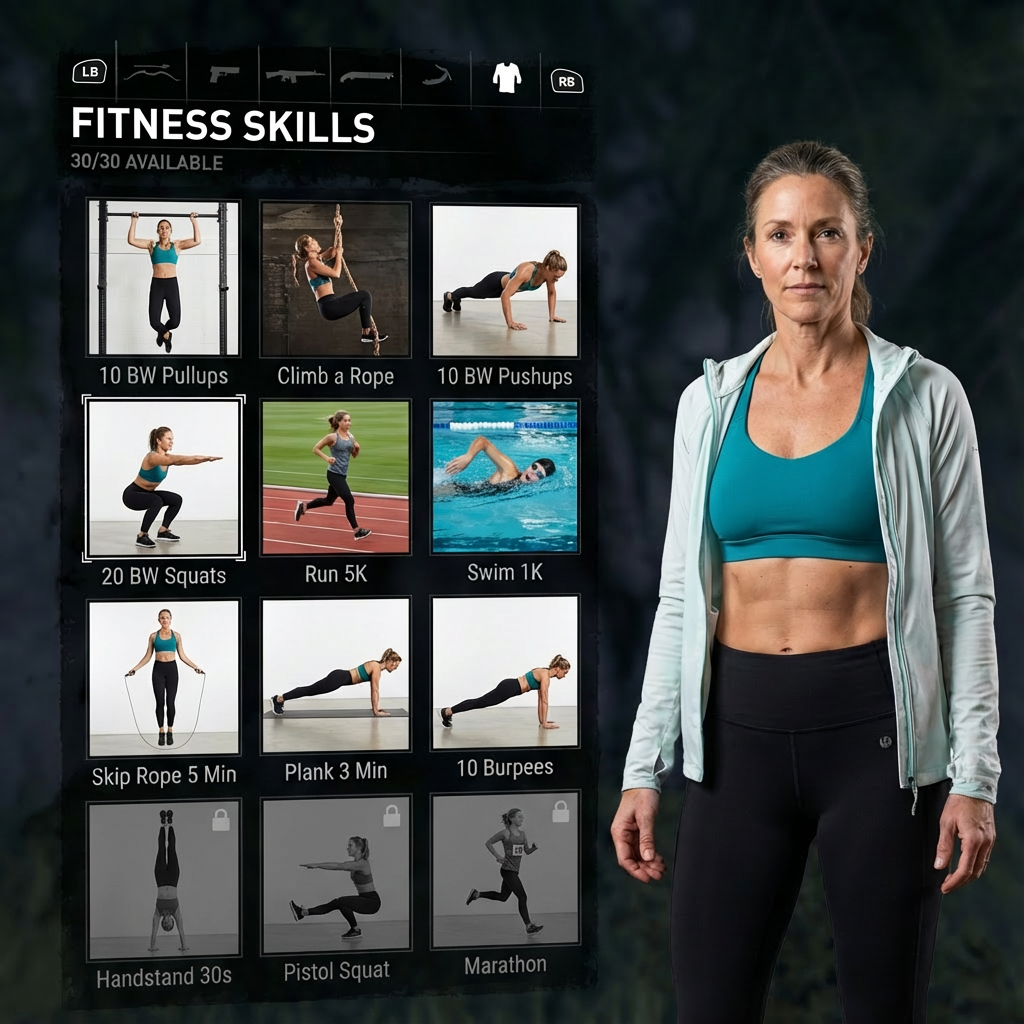
When progressive overload is framed as a sequence of skills rather than a sequence of punishments, training changes fundamentally.
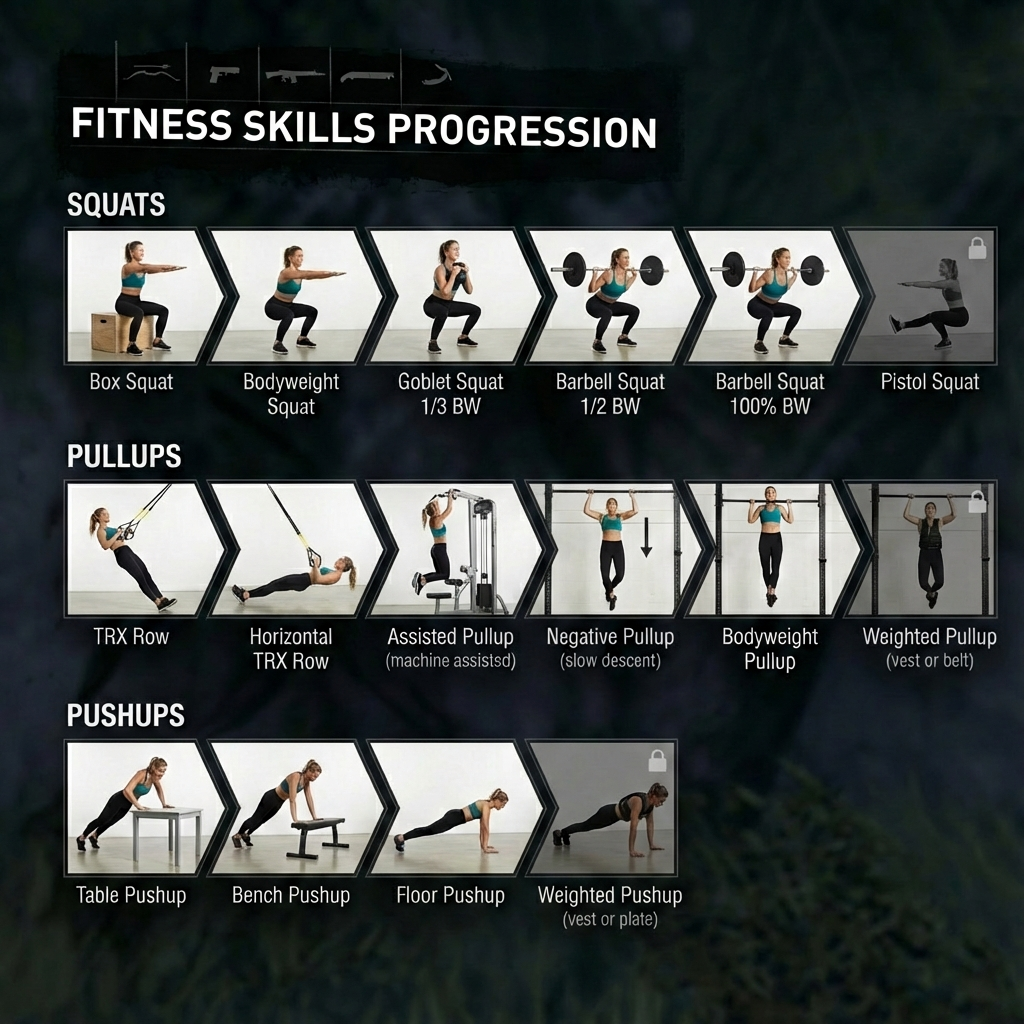
Each movement becomes a “level,” not in a superficial sense, but as a meaningful step in a continuum. You progress toward a movement, through it, and eventually beyond it.
For example:
A box squat becomes a step toward a full squat
A knee push-up becomes a step toward a floor push-up
A row on the TRX becomes a step toward a full pull-up
The load increases, but so does competence, confidence, and understanding. Progress is no longer measured solely by exhaustion or soreness, but by what you can now do that you couldn’t do before.
This taps into several powerful psychological principles:
Competence: seeing tangible improvement reinforces engagement
Autonomy: understanding the process increases ownership
Mastery: skill acquisition creates intrinsic motivation
Training stops being something external imposed on the body and becomes an internalised process of development.
Why this approach supports long-term consistency
When training is structured as progressive skill acquisition, setbacks are recontextualised.
A missed session does not “ruin the program.” Plateaus and temporary regressions become part of the inherently non-linear nature of progress, rather than signs that something has gone wrong.
Because the focus of this system is a set of skills with a long learning curve, achievements are the result of months — often years — of work. Progress is not limited to conditioning the body (getting stronger, more mobile, or fitter), but also involves cognitive learning: understanding movement, refining coordination, and developing better judgement around effort and recovery.
This has two main advantages.
1. Progress becomes more durable and less volatile.
Skill-based adaptations tend to persist far longer than short-term changes in body composition or conditioning. Strength, movement competence, and coordination are harder to “lose” and quicker to regain after interruptions.
This is particularly important for people training under real constraints: limited time, high stress, frequent travel, or inconsistent schedules. When life interferes, progress slows, but it doesn’t reset to zero.
2. Progress becomes clearer and more motivating.
A skill-based framework provides concrete reference points. You can clearly see what you were capable of at the start, what you can do now, and what lies ahead as the next challenge.
This creates a sense of continuity and direction. Progress is no longer abstract or dependent on external validation. It stimulates curiosity about what is possible next, rather than anxiety about maintaining a fragile outcome.
In this context, consistency is not enforced through discipline alone.
It emerges naturally from a system that rewards learning, adapts to reality, and gives meaning to effort over time.
From appearance to capability
One of the most significant consequences of this approach is a gradual shift in priorities.
Aesthetics do not disappear, but they stop being the main reference point by which progress is judged. Instead, attention moves toward what the body can actually do. Strength, movement quality, coordination, and control become more meaningful indicators of progress than appearance alone.
Learning to squat well, press one’s own bodyweight, or move through space with intention requires time, practice, and problem-solving. These are not passive outcomes. They demand engagement with the process and an understanding of one’s own limitations and potential. Over time, training becomes less about chasing a visual endpoint and more about developing competence.
The result is a different relationship with training. People stop seeing themselves as bodies to be shaped and start seeing themselves as agents who can perform, adapt, and improve. This is particularly evident as age increases or when setbacks occur. Capabilities can be rebuilt, refined, and expanded even when circumstances change.
That identity, being someone who can do things, learn skills, and progress over time, is far more stable than any single physical outcome. It does not rely on constant optimisation, nor does it collapse when progress slows. It gives training meaning beyond the mirror and makes long-term engagement far more likely.