Bodyweight vs Weights False Dicothomy
There’s a strange and persistent divide in fitness culture.
Bodyweight training is often framed as “functional,” “natural,” and good for posture and longevity.
Weights and barbells, on the other hand, are sometimes portrayed as bulky, aggressive, or unnecessarily hard on the joints.
As if the two approaches belonged to different philosophies, where choosing one automatically excluded the benefits of the other.
Also, many people attach their identity to a method.
“I’m a calisthenics person.”
“I only do Pilates.”
“I only lift weights.”
“I don’t do machines.”
In reality, this is a false dichotomy.
From a physiological standpoint, your body doesn’t recognise training styles or brand names. It doesn’t know whether you’re doing calisthenics, Pilates, or barbell work.
Your body responds to stimulus, not tools
The body only responds to mechanical stress, specifically, how hard it is and how long it is applied for. The rest is just marketing.
How hard the effort is.
How much total work you accumulate.
How long the muscles are under tension.
How much range of motion you train through.
How frequently you repeat the exposure.
Whether those demands gradually increase over time.
Intensity, volume, time under tension, density, range, progressive overload.
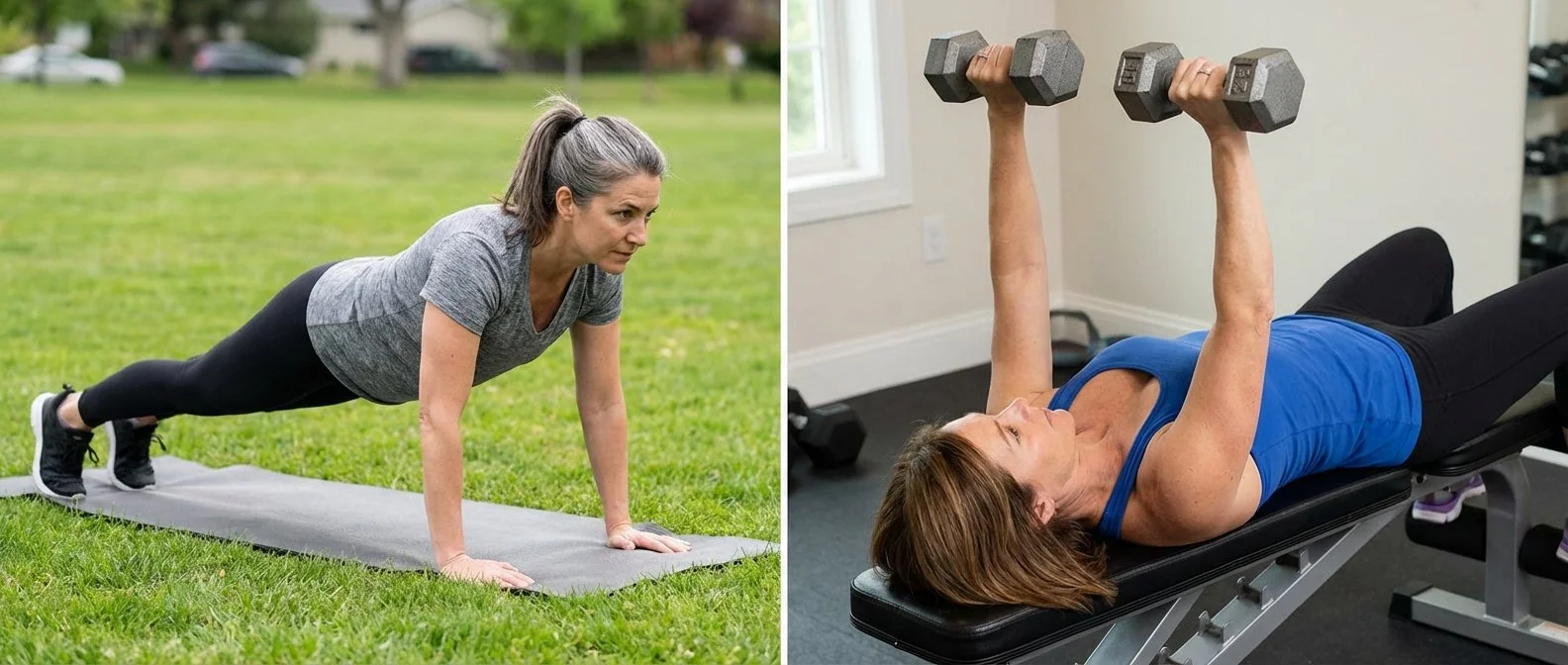
A push-up and a bench press are simply different ways of creating similar demands around the shoulder and chest, and the ability to push something away from you. One uses bodyweight, while the other uses plates, but the tissue response follows the same rules.
If the stimulus is sufficient and repeated consistently, the body adapts. If it isn’t, nothing happens.
This is why arguing about methods often misses the point. Two people can both “do calisthenics” and get completely different results depending on how they train. The same is true for weights.
Specificity still applies
That said, training is not completely interchangeable.
Specificity is an important principle that shapes how we choose exercises. Meaning, you tend to improve at what you actually practice.
If your goal is better push-ups, doing push-ups regularly makes sense.
If you want a stronger bench press, you need to bench press.
If you want to control your body upside down, you need time spent upside down.
General strength carries over, but skills are still skills.
This is where bodyweight and weights start to reveal different practical advantages. Not because one is more “functional,” but because each solves slightly different problems.
Where bodyweight training shines
Bodyweight training has a simplicity that is hard to beat.
You don’t need a gym.
You don’t need machines.
You don’t need much setup.
For people who travel frequently, train outdoors, or simply don’t want their consistency to depend on access to equipment, this is a major advantage. The barrier to entry is low. You can do something almost anywhere.
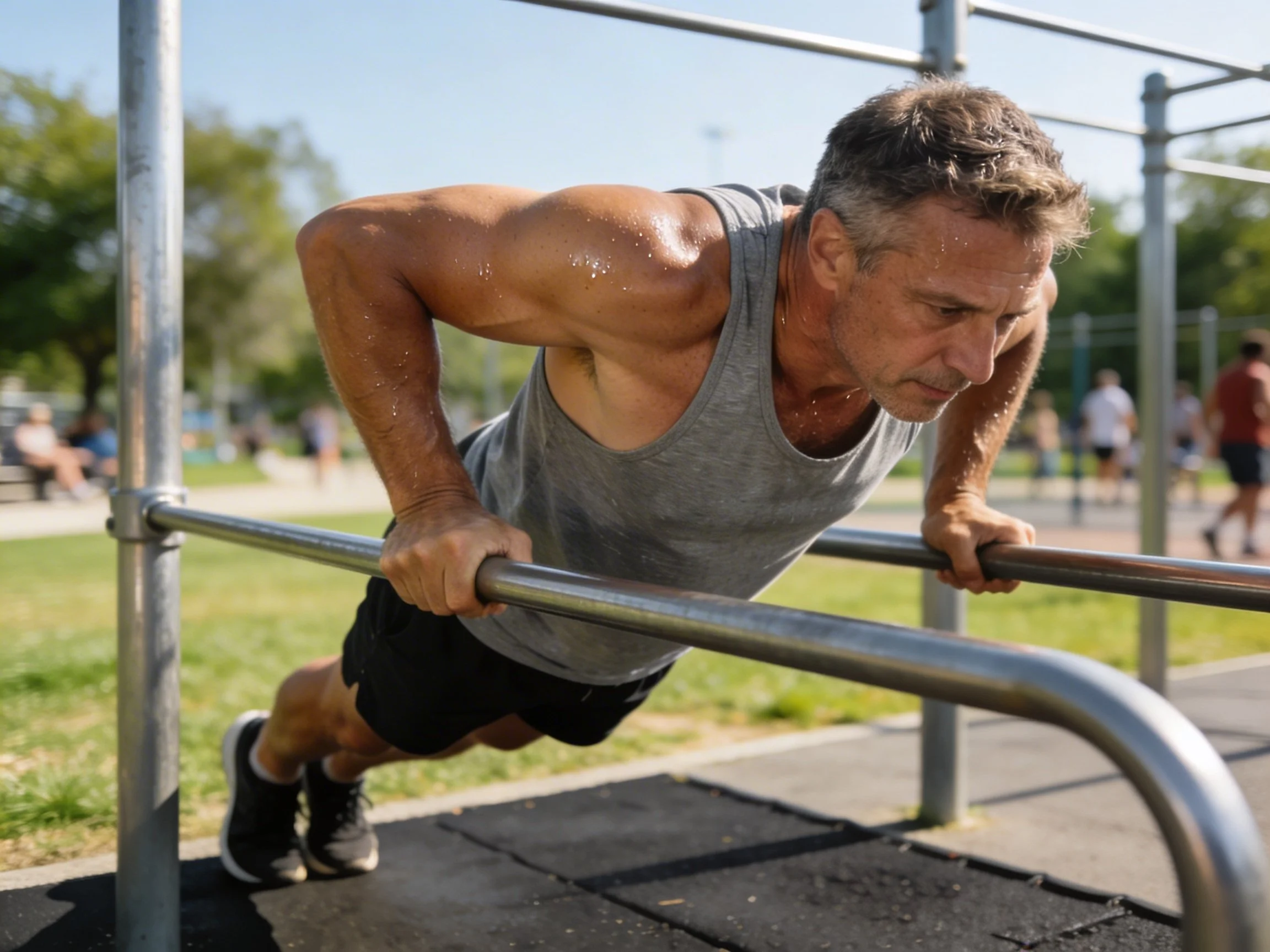
It also tends to encourage a closer relationship with movement quality. Because you are moving your entire body through space, coordination, balance, and spatial awareness develop naturally alongside strength.
Pull-ups, dips, handstands, crawling patterns, and single-leg work demand a certain level of control and ownership of your body. Over time, this often translates into better posture, better joint awareness, and a feeling of athleticism that people sometimes struggle to get from purely machine-based training.
There is also a strong psychological component. Bodyweight skills feel tangible and satisfying. Learning your first pull-up or handstand carries a clear sense of progress. You’re not just adding five kilos to a bar — you’re doing something you previously couldn’t do at all. For many people, that skill-based progression is more engaging and easier to stick with long-term.
However, these same qualities can also become limitations.
Bodyweight is harder to scale
Bodyweight exercises often have a higher technical and strength threshold before they become productive.
A push-up is manageable for most people, but what about a pull-up? Or a dip? Or a handstand push-up?
For beginners, these movements can be too demanding to train effectively. If you cannot yet perform the movement for enough quality reps, you’re stuck between exercises that are either too hard to practice or too easy to create adaptation.
Progressions exist, of course, but they’re not always precise. You can’t reduce a pull-up by exactly 2 kilograms the way you can with a machine or dumbbell. Adjustments tend to be larger and less granular.
The issue of limiting factors
In many bodyweight skills, strength isn’t the only demand. Balance, coordination, and technique all compete at the same time. If you fail a freestanding handstand push-up because you lose balance, your shoulders might not have received enough stimulus to grow stronger. The bottleneck becomes skill, not strength.
For someone whose goal is simply to build muscle or increase general strength, that can slow progress unnecessarily.
This is often where external weights become extremely useful.
Where weights and barbells shine
Weights allow for precision and are easy to both progress and regress.
The load can be adjusted gradually and predictably. You can add small increments week after week, which makes progressive overload straightforward and measurable. This is one of the main reasons barbells and dumbbells have remained staples of strength training for decades: they make progression easy to quantify.
They also remove many secondary constraints.
If your goal is to strengthen your shoulders, a dumbbell or barbell press lets you focus directly on producing force without worrying too much about balance or complex coordination. The muscles you’re trying to train become the main limiting factor, which often makes strength and hypertrophy work more efficiently.
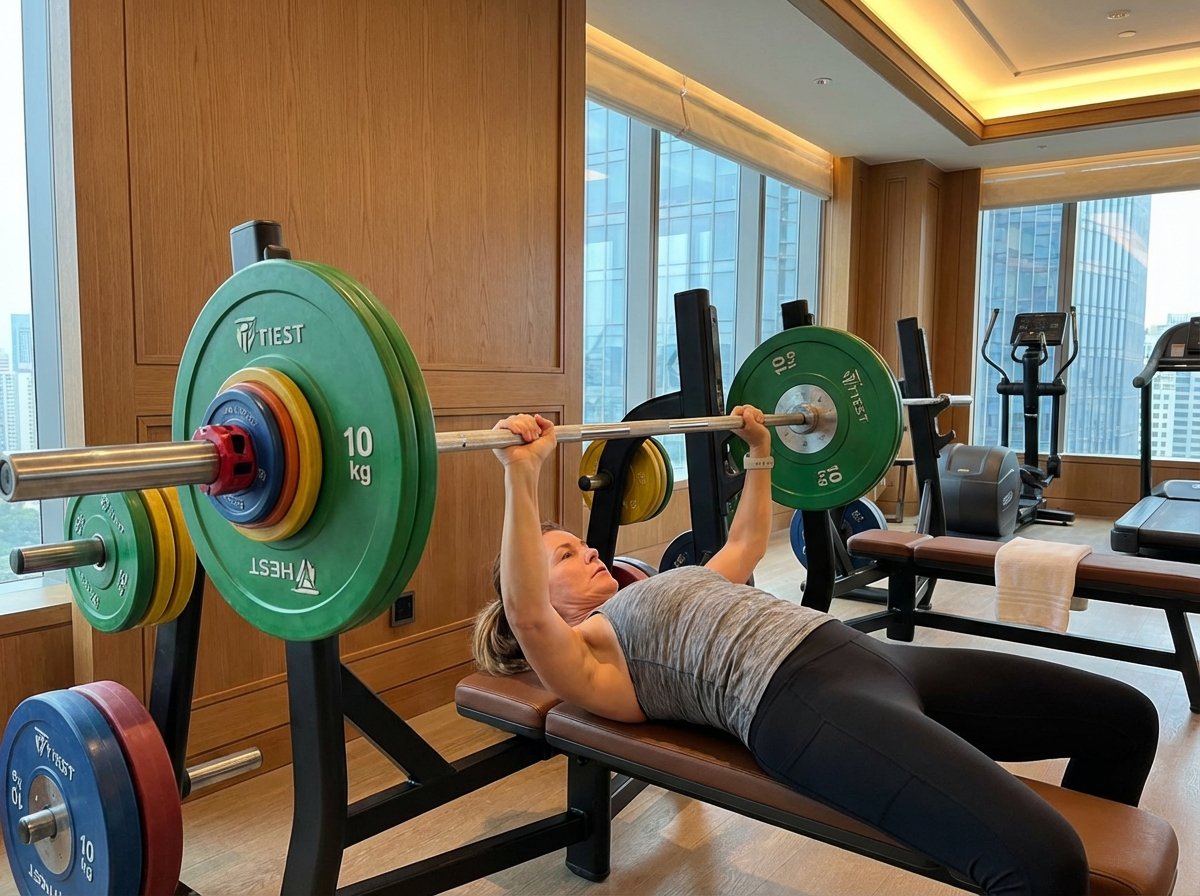
For beginners especially, this can be invaluable. Someone who cannot yet do a single pull-up can still build their back with rows and pulldowns. Someone who cannot do push-ups comfortably can press light dumbbells and progress steadily.
In this sense, weights are often more accessible and scalable. They meet people where they are.
They’re also time-efficient. In busy schedules, being able to load a movement quickly and accumulate sufficient stimulus in fewer sets can make training sessions shorter and more practical.
None of this makes weights inherently superior, but it simply highlights that they solve different problems.
Matching the tool to the person
Once you move past ideology, the picture becomes much simpler.
If you travel a lot and need flexibility, bodyweight work might be the backbone of your routine.
If you’re just starting out and need a gentle, scalable way to build base strength, weights might make more sense initially.
If you enjoy learning skills and want training to feel playful and athletic, bodyweight progressions can be incredibly motivating.
If you want precise, measurable strength increases and efficient sessions, barbells and dumbbells are hard to beat.
Weights to build raw capacity while bodyweight to express that capacity through control and skill, complementing each other far more than they compete.