The Low-Hanging Fruit
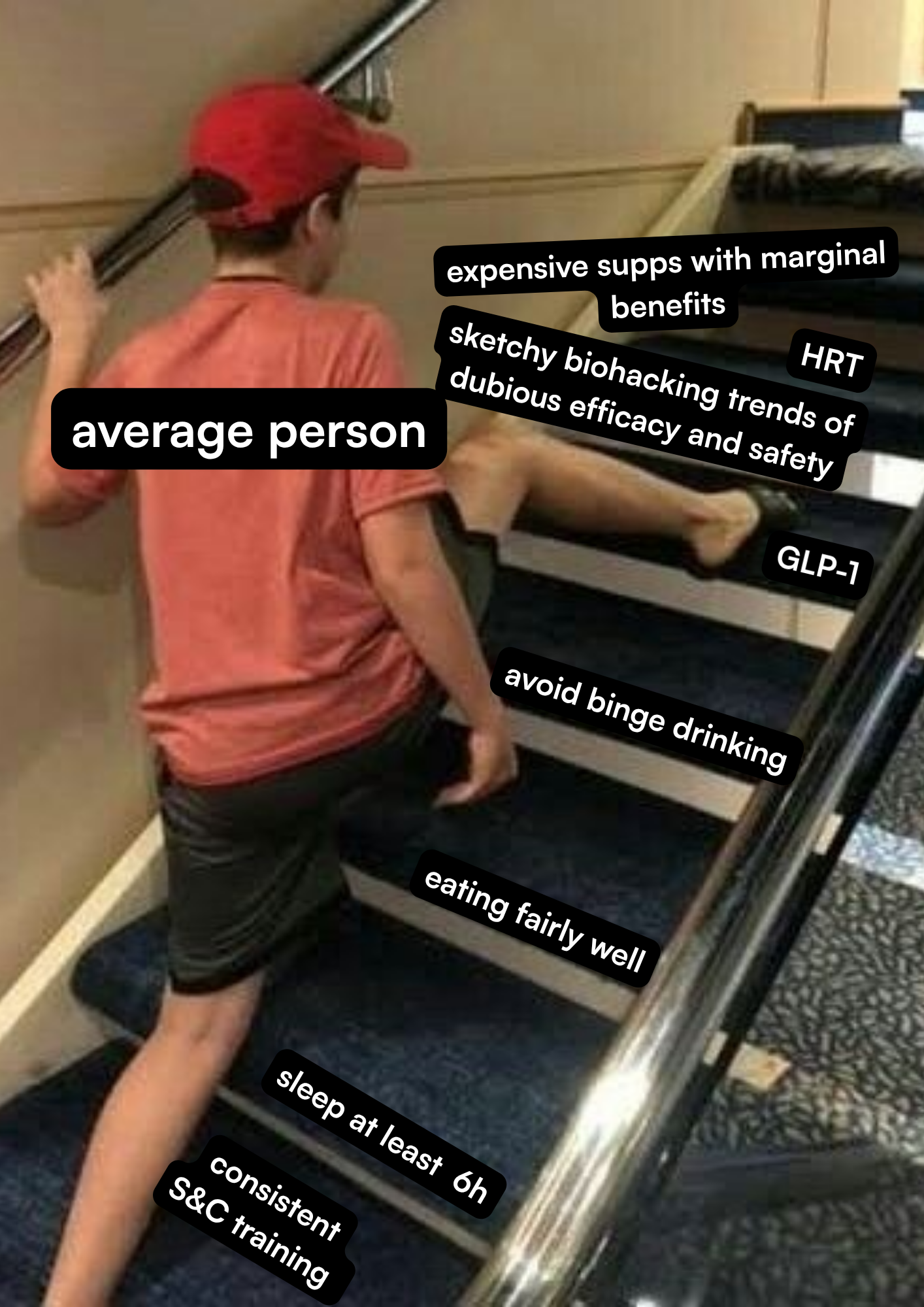
Working in fitness, it is astonishing to see how many people are willing to explore the most advanced, expensive, and biologically invasive interventions available before giving a serious try to the basics. GLP-1 injections, testosterone replacement, stacks of twelve supplements in a monthly subscription box, continuous glucose monitors worn by people without diabetes, infrared saunas, peptide protocols, cold plunges at a medically precise eleven degrees Celsius. Not to mention the edgier experimental compounds.
The Easiest Choice
Officially, a lot of the discourse is built on the assumption that the basics are already in place, and that what you need now are the advanced interventions. For most people, the basics are not in place. They are sleeping for 6 hours. They have never trained consistently for longer than a few weeks, let alone years. Their diet is chaotic. In that context, adding a sauna protocol or a peptide stack is not a small gain on top of a solid foundation.
The wellness industry has understood something important about human psychology: effort is aversive, and novelty is seductive. The brain is wired to seek shortcuts, and an industry worth hundreds of billions of dollars has become extraordinarily skilled at presenting those shortcuts as sophisticated, science-backed, and even morally superior to the unglamorous alternative of just doing the work.
It does this through two levers.
The first is exploiting our preference for the immediate over the difficult.
Technical-sounding explanations (cortisol dysregulation, mitochondrial dysfunction, testosterone insufficiency ) frame the problem as a discrete biochemical failure that a discrete product can fix. The health anxiety wellness culture generates so effectively the constant suggestion that you are falling behind, that your biology is subtly failing, that others have an insight you lack.
The idea that the body responds to consistent training, adequate nutrition, and rest in ways that address most of these complaints is not very glamorous and too free to make a convincing sales pitch.
The second lever is subtler: the gamification of biohacking.
Each supplement, protocol, and diagnostic test becomes an earned badge. Cold plunge, check. Red light panel, check. Hormone panel, check. Peptide cycle, check.
There is a collector's logic to it that makes accumulating interventions feel like progress. It is deeply effective, and almost entirely disconnected from actual outcomes. The badge-collecting gives the sensation of building something without requiring the one thing building actually demands: sustained, unglamorous effort over time.
The Miracle Drugs
GLP-1
I once heard an anecdote from bodybuilders back in the 90s. They routinely used cocaine in the pre-contest period to suppress hunger, shred, and grind through hard training sessions while in a strict calorie deficit.
GLP-1 drugs are genuinely remarkable molecules. That needs to be said plainly, because what follows is not a dismissal of their legitimate medical utility. The problem is the context in which they are now being used. The number of US patients without diabetes who were prescribed GLP-1 receptor agonists increased by approximately 700% over a 4-year period through 2024.
From their original clinical indication, they permeated into the much broader consumer market of people who are using them primarily for aesthetic weight loss or body composition goals. Goals that, for many of them, could be achieved through the application of inexpensive basic principles that carry none of the uncertainty these drugs bring with them.
The long-term tolerability and efficacy of these medications beyond two years of treatment is, in the words of the research, simply unknown, as these drugs have been deployed at a mass scale for obesity for a very short time.
The Muscle Loss Question
Multiple studies confirm that roughly 25% to 40% of the weight lost on GLP-1 drugs is muscle, not fat.
The drugs suppress appetite strongly enough to create the equivalent of severe caloric restriction. Severe restriction without resistance training eats muscle alongside fat.
The GLP-1 prescribing guidelines actually specify that the drug is intended as a complement to increased physical activity and dietary changes. In practice, that guidance is widely ignored. Many people are willing to trade spending significant money and accepting uncertain long-term risks for the ease of immediate results, the pursuit of body-dysmorphic standards, and to avoid having to come to terms with their eating habits.
A University of Cambridge modelling study published in early 2026 found that people who stopped taking GLP-1 drugs regained an average of 60 percent of their lost weight within a year, and that it remained unclear whether the regained weight was distributed proportionally between fat and muscle, or whether, as the researchers warned, the fat-to-lean ratio might be worse after cessation than it was before starting. If the regained weight is disproportionately fat, some patients may end up metabolically worse off than they began. The very thing they took the drug to fix may be more entrenched when they stop.
HRT
In the year of the lord 2026, there is finally a middle ground forming between the testosterone-fueled bodybuilders and the puritanism against hormone replacement therapy.
The medical view on these therapies has shifted considerably in the past few years, so much so that recently, the FDA has even removed black-box warnings from many HRT products. The current consensus is that for many people (particularly those who are closer to the onset of menopause and using appropriate formulations), the benefits can reasonably outweigh the risks.
What is less discussed is who HRT is actually designed for. Testosterone therapy in men without a diagnosed deficiency, or oestrogen supplementation in women who are not yet experiencing significant symptoms, are different clinical propositions entirely. The risks do not disappear because the marketing is more confident. There is a particular generosity that men over 40 (although sometimes even younger than that) extend to themselves on this topic. Turning 40 has become, in certain wellness circles, a kind of automatic justification for testosterone replacement, regardless of what the bloodwork actually says or what the lifestyle looks like.
The risks vary a lot depending on formulation, dose, and duration, and require real clinical judgment on whether they’re worth it or not. What the wellness industry has done is flatten all of that complexity into a universal performance upgrade, aimed at people for whom these drugs were never intended.
It has to be said also, that much of the decline that gets medicated is, in a meaningful part, a sedentary lifestyle problem. Research consistently shows that inactive older men are significantly more likely to fall into clinically low testosterone ranges than men who remain vigorously active. The hormone panel looks different, not just because of age, but because of what the body has been asked to do.
Supplements
The supplement industry operates under a regulatory framework that would not be tolerated in any other area of medicine. In the US, the FDA cannot review supplements for safety or efficacy before they go to market. Hence, manufacturers do not need to submit evidence that their products work, or even that they contain what the label says.
The only real restriction is that they cannot claim to treat specific diseases, while everything else, every vague promise about energy, immunity, hormonal balance, and cellular health, is allowed.
The predictable result is a market flooded with products that have little to no meaningful evidence behind them. Except for a small number of well-supported exceptions (vitamin D, protein supplements, caffeine and creatine), most of what you see on the shelves has no solid scientific backing and relies on testimonials, influencer endorsements, and before-and-after photos.
Then there are peptides. The new obscure trend circulating in wellness and fitness circles.
Many of these have never been tested in human clinical trials, sold in grey markets, often as "not for human consumption".
They are research compounds, meaning they exist in the literature as preliminary or animal studies, claiming benefits such as improved recovery, fat loss, muscle growth, better sleep, enhanced cognition, anti-aging effects and plenty more.
Their appeal is easy to understand:
they feel clinical and scientific
carry none of the social stigma of anabolic steroids (while operating on many of the same biological pathways and outside of the regulatory framework).
They’re only a click away and easily purchased online
A way around it?
There is a reason this conversation keeps circling back to complicated interventions rather than simple ones.
Training, in a sustained, progressive, consistent way (not the three-week burst followed by a three-month pause that most people's exercise history actually consists of), is challenging, in a way that resists the modern appetite for frictionless self-improvement.
Sustained means years, not months. Consistent means showing up when you are tired, travelling, busy, and unmotivated. Intelligent means learning how to train, how to manage recovery, how to navigate around injuries and how to eat enough of the right things.
Taking injections is passive. Filling a supplement case is passive.
Lifestyle change is hard, less glamorous and requires the development of skill, the tolerance of delayed gratification, and the acceptance that the results emerge slowly and invisibly over a time horizon that is difficult to stay motivated by.
The antidote might be to leverage some of the very mechanisms the industry uses so effectively (the structure, the progression, the sense of earned achievement) towards the behaviours that actually deserve them. That is the argument I explored in a previous piece on The Gamification of Progressive Overload, and it is worth reading alongside this one.
The low-hanging fruit requires climbing the tree. It is, by a wide margin, the tree worth climbing.