Why You Should Not Trust Your Wearables
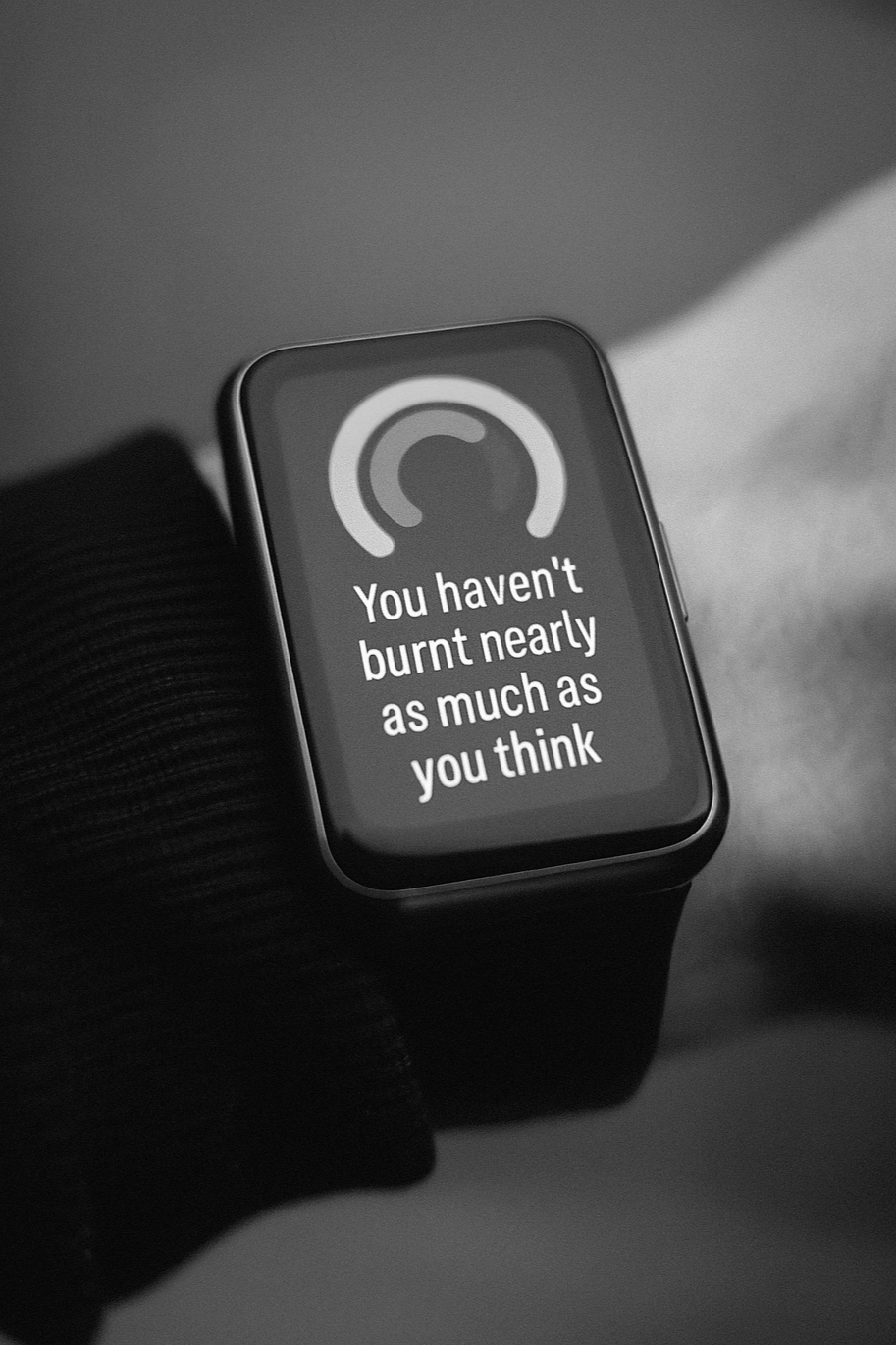
Fitness trackers have become part of daily life. Watches and bands promise to count your steps, measure your heart rate, and even tell you how many calories you’ve burned. For many, those numbers become the foundation of diet and training decisions.
But here’s the problem: wearables are notoriously unreliable when it comes to estimating calorie burn. While they can be useful for tracking trends or keeping you motivated to move, the actual calorie numbers are often far from accurate.
Real-World Accuracy: What the Research Finds
Wrist Devices Are Fine for Heart Rate — Not for Calories
In the study “Accuracy in Wrist-Worn, Sensor-Based Measurements of Heart Rate and Energy Expenditure in a Diverse Cohort” (Shcherbina et al., 2017), researchers tested seven popular wrist devices — including the Apple Watch, Fitbit Surge, and Samsung Gear S2 — on 60 volunteers performing different activities (sitting, walking, running, and cycling). The readings were compared against gold-standard laboratory measures of heart rate and energy expenditure.
During cycling, six devices had a median heart rate error under 5%.
None of the devices managed to estimate calorie burn with an error below 20%.
The Apple Watch performed best overall, while the Samsung Gear S2 performed the worst.
Errors were larger in walking, and among people with higher BMI, darker skin tone, and males.
The authors concluded that while wrist-based heart rate readings can be acceptable in controlled settings, calorie (energy expenditure) estimates are too unreliable for precise use.
Across 65 Studies: The Same Problem Repeats
A large systematic review, “Accuracy and Acceptability of Wrist-Wearable Activity-Tracking Devices” (O’Driscoll et al., 2021), analysed 65 studies involving 72 different devices. The results were remarkably consistent:
Step counts: Some devices (like the Fitbit Charge / Charge HR) had errors under 25%.
Heart rate: The Apple Watch performed best, usually staying within 10%.
Calories burned: Every brand tested showed errors over 30% — meaning poor accuracy across the board.
Despite this, the review found that people generally liked wearing these devices. Data availability and wearing time were high, showing that users found them acceptable even if their calorie numbers weren’t trustworthy.
In short, none of the tested wrist devices provided reliable calorie estimates.
More Recent Findings
The study “Validity of Apple Watch 6 and Polar A370 for Monitoring Energy Expenditure” found that the Apple Watch 6 often overestimated calorie burn, with errors ranging from –6.6% to +53.2% depending on activity. The Polar A370 also varied widely.
Similarly, in “Reliability and Validity of Commercially Available Wearable Devices”, researchers concluded that no brand delivered acceptable accuracy for energy expenditure across real-world conditions.
Why Are Calorie Estimates So Inaccurate?
The consistent pattern across all studies highlights several underlying problems:
Generic algorithms: Most devices rely heavily on basic user data (like body weight and age) and simplified models of metabolism, which don’t adapt well to different intensities or movement styles.
Poor sensitivity to intensity changes: Devices often misread fluctuating effort — for example, during interval training or resistance exercises.
Bias across users: Shcherbina et al. (2017) found that error rates were higher for people with higher BMI and darker skin tones, showing the algorithms aren’t universally reliable.
Activity-specific accuracy: Trackers do better during steady cardio, like cycling, but perform much worse during walking or mixed daily activities.
What This Means for Your Training and Nutrition
With typical calorie burn errors between 20–30% or more, using these numbers to fine-tune your diet can easily backfire. If your watch says you burned 500 kcal, the real number could be anywhere from 350 to 650 kcal — a range that makes a big difference over time.
Still, wearables have their place:
Track trends, not absolutes: Comparing your activity from one week to another can still be useful.
Stay motivated: The behavioural nudges — steps, reminders, challenges — help many people move more.
Trust heart rate more than calorie and step numbers.
Should You Bin Them?
Wearables are powerful tools for increasing awareness and motivation — but when it comes to calorie tracking, the science is clear: they’re estimates, not facts.
So next time your watch tells you you’ve “burned 500 calories,” take it as a ballpark figure, not a precise measurement. Use it to stay consistent, not to calculate your next meal.